

Video above is an excerpt from a video currently in production; please share it and subscribe because the final version will be ready soon and will be more detailed and will be the foundation for upcoming episodes/installments in this series.
MUSICAL PSYCHOMODULATION AND TONAL NEUROMODULATION
The previous video and article in this series (which I am organizing now) are provided below. The final version of the video excerpted above will hopefully be ready later today or certainly by tomorrow…unless Trump continues to provoke inter/intra-national chaos, which is en route to inter/intra-national war.
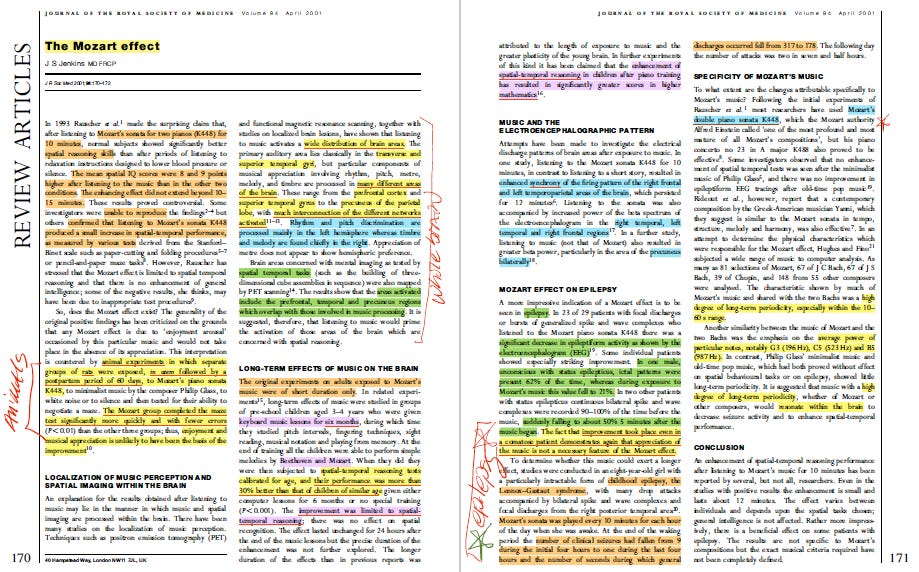
I have provided my personal annotated PDF copy of this article (Jenkins, 2001) at the bottom of this page.
MUSICAL THINKING and TONAL NEUROMODULATION (pt2)
In today’s video, for the first time despite my other conversations about music, I get into the concepts, evidence, and mechanics of what I will call here “MUSICAL NEUROMODULATION” which is based upon and extends beyond the insufficiently famous and frequently fumbled Mozart effect.
I will discuss and provide a reading of the 2001 article by Dr Jenkins published in Journal of the Royal Society of Medicine, which is one of the best and basic reviews on the topic, which is sufficient for us to understand some of the major concepts and data points that substantiate both the fundamental concept of the Mozart effect and—more importantly—how this concept can be extended far beyond what is commonly said about it.
I have provided my personal annotated PDF copy of this article toward the bottom of this page.
Today’s video review likely includes nearly everything that we need to know about this concept and its implementation—again—extending beyond what is commonly discussed in the biomedical literature and common superficial conversations. However, I will provide additional reviews in the future to extend and modify these ideas.
MUSIC MATTERS FOR THE MIND (part 1) in two important ways:
First: QUANTITATIVELY—because we generally spend hours and ultimately years listening to music, either directly/attentively or passively, whether we choose it or if it is in the background and ambiance of other settings such as while working, shopping, eating, and exercising; as such, musical patterns and especially any accompanying lyrics eventually become “hard-wired” into our neural brain circuitry and thereby influence our perspectives, mood, and abilities as an extension of the Mozart effect.
Second: QUALITATIVELY because of the aforementioned “rewiring of the brain” depending on the quality, complexity, and cleanliness (when instrumental) or contamination (with lyrics) of the music. Occasionally, we are seduced by tonality that carries new ideas in the accompanying lyrics, and this eventually forces us to change our perspectives and thereby change our lives.

Dr Alex Vasquez, January 2026
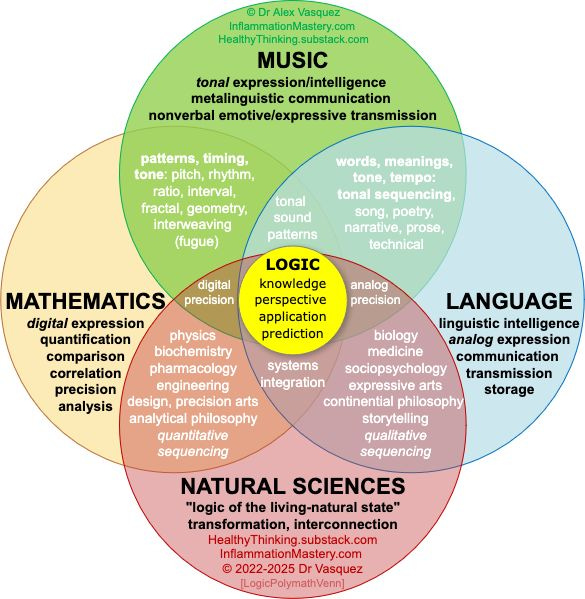
Index of “my favorite songs” listed and linked below in the following order:
Funk
Italian
Epic live performances
Men and masculinity
Colombian-Irish song with my translation
Traveling
Relocating
Portuguese
Bossa nova

I have provided my personal annotated PDF copy of this article (Jenkins, 2001) at the bottom of this page.


