

Be sure that you are subscribed to the email newsletter to receive the upcoming larger video and the additional videos in this conversation on CLINICAL NUTRITION PHARMACOLOGY: Classes that You Never Received
VIDEO TUTORIAL: Research Analysis + Clinical Decision-Making [FINAL EDITS + NOTES]
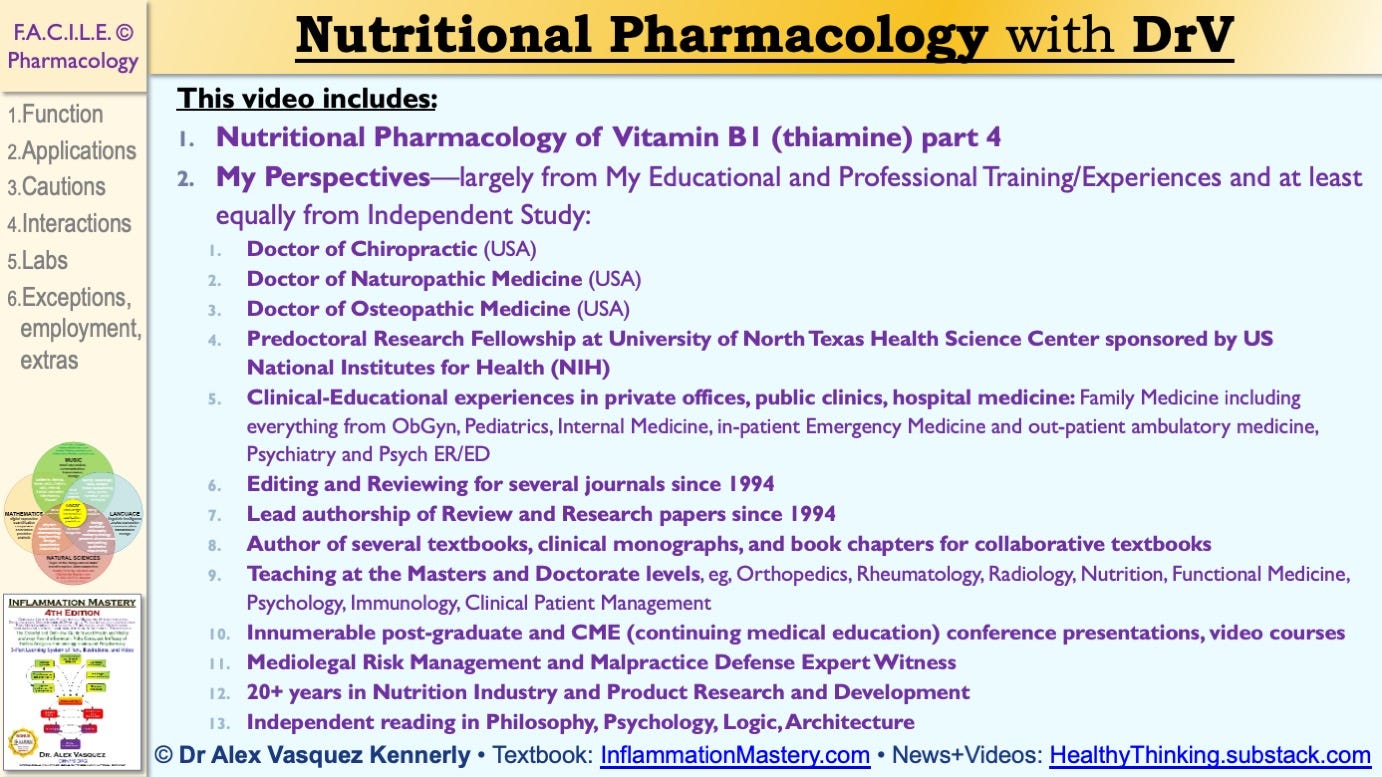
NEW NOTES HAVE BEEN ADDED THROUGHOUT THE VIDEO:
Formal education is popularly attacked these days for its shortcomings (especially after the catastrophic failures and collusions that occurred during the globalist pandemic) mostly by people with little formal education. However and to its merit, formal education includes much more than simply information (and indoctrination), as it can also include
practical experiences,
mentoring from experts with 40+ years of successful experience,
innumerable corrections (ie, humility [for those who can receive and learn from corrections]),
treatment and management strategies and techniques, etc.
Self-education is great and necessary for everyone, whether they have studied in formal education or not. But for people who have not been through graduate/doctorate education, how will they know where they are along the spectrum of
simple familiarity?
competence and fluency, ranging from basic to intermediate to advanced?
mastery at a professional level?
The seduction of self-education is that anyone can feel that they understand the material simply because they picked up new vocabulary and some ideas that were easy for them to grasp, but they will have also selectively skipped the parts that were more difficult and they will never have their perceptions and competence challenged by an expert (eg, professor) or system (eg, high-stakes exam) that will slap/humble them back to reality while they stay drunk with their self-impression.
The music clip at the intro is Bella by Qatar Jazz
Teachers/professors have to do more than simply present information; they also have to
select and emphasize what is important and current,
integrate their coursework with the other professors/courses in the program,
write fair exams that hold students accountable to competent levels of professionalism,
accurately evaluate and correct the work of the students,
have the courage to fail students who fail to perform to proper standards, including life-and-death standards within the study of healthcare topics for clinicians.
Generally speaking, we respect two different hierarchies of evidence especially when making decisions with human patients.
First, we have a hierarchy of types of evidence along the continuum from biological plausibility to clinical preference:
Level 1: biochemistry, theory
Level 2: in vitro studies
Level 3: animal studies
Level 4: small open trials, case reports/series
Level 5: controlled studies of low quality
Level 6: randomized controlled studies of high quality
Level 7: high-quality studies in diverse populations, multisite, international
Level 8: duplication of studies to confirm benefit, comparison with current treatments
Level 9: consensus, scientific
Level 10: consensus, clinical
Second, we have a hierarchy of publications of evidence: 1) small conference abstracts, 2) letters, 3) case reports/series, 4) open trials, 5)DBPCR trials smaller to larger, worse to better, 6) reviews then meta-analysis. Any of these might be brilliant and treatment-changing (rarely in isolation) or total garbage and propaganda, eg, Murai JAMA 2021 Mar PMC7890452
Young inexperienced headstrong students and fledgling clinicians tend to overestimate the validity of the few articles they have read because they don’t have clinical experience, teaching experience, research/authorship experience, and they have never had the inevitable sweat-inducing sphincter-cramping medicolegal challenges that enforce a much higher external standard of critical analysis, cross-analysis, and second-guessing (ie, Freud’s superego or my “metaego” or “overego” concept, mentioned previously).
You can be [darn] sure that nobody at level of an experienced professor/author in the world of clinical care and Specialty Medicine is going to justify their clinical interventions based on an in vitro study, an in vivo/animal study, or a poorly conducted human clinical trial; just try playing those games with a high-level clinical specialist and they will knock you into a new reality—for which you should thank them.
Clinical trial checklist:
Study design
Patient demographics
Perfect clarity on the different interventions, especially if they are trying to use a fake placebo
Too many variables between the interventions makes clear comparison impossible, eg, dosage, forms, routes (PO vs IV or SQ/IM), timing at onset, frequency, duration, lag between intervention and testing
Comparable groups in different arms of the study; quality of randomization, same dose/duration/treatment, precise number of people in each group, same severity and comorbidities
Competent review of previous research; the new research should build upon previous standards and should have a reasonable chance of safety and effectiveness; appropriateness of interventions and assessments
Don’t confuse pharmacokinetics, pharmacodynamics, (whatever) lab tests, vs what really matters: clinically important outcomes
Look for inconsistencies in the data to find unwritten inconsistencies in the intervention, especially when the details are not provided. Too many differences in outcomes points to bad randomization, differences in treatment dosage, duration, etc
Corrupt research is designed to look like research but uses bad methodology, unequal comparisons, and fraudulent markers to create the illusion of efficacy, equivalence, or inefficacy—usually tailored to the profitability of the sponsor, including the journal’s advertisers.
CONCLUSION: The authors of this paper are trying very hard to show that their obviously prefered intervention is superior, but what they found instead is a 1) lack of consistent pharmacokinetics, 2) lack of dose-absorption and dose-effect relationships even at the same dose, 3) clinical equivalence with the competitor which was probably easier to administer, had better compliance, and was probably less expensive. The final nail in the coffin of this study is that the clinical outcomes were clinically equivalent and “nonsuperior” among the different groups and interventions. THEIR CONCLUSIONS ARE NOT AT ALL SUPPORTED BY THEIR FINDINGS, AND THEIR METHODS AND DESCRIPTION ARE HORRIBLE.

The question we are trying to answer is:
What is the best form of Vitamin B1—regular thiamine, TTFD, or benfotiamine?
To arrive at the most reasonable answer after looking at this data about 5 times (ie short of doing a “Sherlock Holmes-level” forensic investigation, I have reviewed the following articles as discussed in this video review:
Marrs C, Lonsdale D. Hiding in Plain Sight: Modern Thiamine Deficiency. Cells. 2021 Sep 29;10(10):2595
Park WS, Lee J, Hong T, Park G, Youn S, Seo Y, Lee S, Han S. Comparative Pharmacokinetic Analysis of Thiamine and Its Phosphorylated Metabolites Administered as Multivitamin Preparations. Clin Ther. 2016 Oct;38(10):2277-2285
Overton E, Emelyanova A, Bunik VI. Thiamine, gastrointestinal beriberi and acetylcholine signaling. Front Nutr. 2025 Apr 9;12:1541054
Talwar D, Davidson H, Cooney J, St JO’Reilly D. Vitamin B(1) status assessed by direct measurement of thiamin pyrophosphate in erythrocytes or whole blood by HPLC: comparison with erythrocyte transketolase activation assay. Clin Chem. 2000 May;46(5):704-10
CLINICAL NUTRITION PHARMACOLOGY Classes that You Never Received: Vitamin B1 (thiamine) by Dr Vasquez
Thiamine (vB1) Pharmacology, Part2: This (excerptable) section starts 54 minutes into the previous introduction and contextualization which will be posted separately in its entirety soon once I have had time to edit, process, and post it.
Reading critically is best done by starting with a conundrum in mind:
what are we trying to accomplish?
Levels of Understanding for Clinical Implementation:
1) pharmacokinetics, especially absorption, then intracellular uptake, then intracellular conversion to active forms
2) pharmacodynamics, production of biochemical effects,
3) physiology, changes cellular behavior,
4) clinical safety, for short-term use
5) clinical benefit,
6) therapeutic justification, superiority/inferiority
7) disease-drug interactions
8) long-term safety
See the previous “Vitamin B1 (thiamine) CLINICAL NUTRITION PHARMACOLOGY: Introduction to Classes that You Never Received” provided below:
QUESTIONS and DEFINITIONS:
Given that a patient has a diagnosis of IBS, then you know that they have SIBO, and therefore you know that they have __________ and/or __________ and you should immediately start treatment with __________ and __________.
Orwellian thought-stopping cliche: used when a person is too ignorant and too indoctrinated to engage in legitimate conversation, they simply/reflexively parrot their indoctrination
What is the difference between NUTRIENT DEFICIENCY and NUTRIENT DEPENDENCY?
What are COFACTORS and what are COENZYMES?
What are the 3 types of beriberi?
What is the difference between AN ENZYME and A COMPLEX?
What are the causes of CONFABULATION?
What are the 5 cofactors for PDhC?
What is the way to DISINHIBIT the PDhC?
WHAT ARE THE APPROPRIATE CLINICAL DOSAGES FOR ADULTS FOR EACH OF THE TREATMENTS described in this video?
______? dosed at ______? mg per day for adults
______? dosed at ______? mg per day for adults
______? dosed at ______? mg per day for adults
______? dosed at ______? mg per day for adults
______? dosed at ______? mg per day for adults
______? dosed at ______? mg per day for adults with the dosage given at morning or night?
Thank you for supporting this archive of information for the cost of a coffee while I am working—about $4.20—for the hours, days, months and years developing this archive which now contains more than 1,000 pages and hundreds of hours of videos on a wide range of topics including Clinical Nutrition (including the Vitamin D series of Videos and Scientific Publications), Antiviral Strategies, Microbiome+Dysbiosis (CME series of >12 videos), Functional Medicine (conference videos) and Pharmacology (of Vitamin B12 and Pediatric Injections,.. Leadership, Critical Analysis of Research and Social Events, architecture, music(Celibidache), philosophy, and a few tutorial videos on fun topics like how to select a good wine/whiskey(and minimize the risks)! HealthyThinking.substack.comincludes a wide range of topics including music, politics, architecture, logic, philosophy, recipes (ie, “everything”) plus “Health Homework” (series)to inform and remind you about important health-promoting actions…whereasInflammationMastery.substack.com attempts to be more/strictly clinical and specific to book updates, clinical research and protocols.
Microbiome Dysbiosis (1) Course Overview and Introduction to Major Concepts and Mechanisms
Microbiome Dysbiosis (3) Prototypes of Dysbiosis-Induced Disease (VIDEO:1hour,42minutes=102minutes)
Microbiome Dysbiosis (7) Dysbiosis by Location—Genitourinary Tract
Microbiome Dysbiosis (8) Dysbiosis by Location—Blood, Tissue, Parenchymal Dysbioses
Microbiome Dysbiosis (9) Dysbiosis by Location—Skin and Environmental Dysbiosis
MICROBIOME DYSBIOSIS (10) Gut Dysbiosis Prototypes—see the video link provided below


